AI vs traditional email marketing for B2B sales
 Researched and Written by
  Reviewed and Edited by
 Traditional email marketing is becoming less effective for growing pipelines and driving actual revenue. These systems rely on sending template-based, generic emails to every recipient.
Remember those painful sales blasts addressing us as ‘valued professionals’?
They state a problem and ask for ten minutes of your time to discuss a solution. That type of messaging often confuses us because none of the problems they mention exist in our company.
While email outreach remains foundational to business growth, their workflows have evolved. AI-powered email marketing enables sales teams to set up personalized sequences for a group/individual recipient. Managers can execute multiple strategies with minimal oversight and also see interested users in real-time.
Sales teams must now decide whether to upgrade their systems with email marketing automation or stick with traditional approaches. This blog dives deeper into how AI compares against legacy email marketing systems for B2B sales. It covers how AI transforms sales emails, benefits, and key differences in detail.
What is traditional email marketing in B2B sales?
If your team writes email copies from scratch every morning, manually schedules them, only to send them to a static list, that’s traditional email marketing in practice.
It focuses on generic messaging, rigid outreach sequences, and broad reach to engage with contacts and move them through a sales funnel.
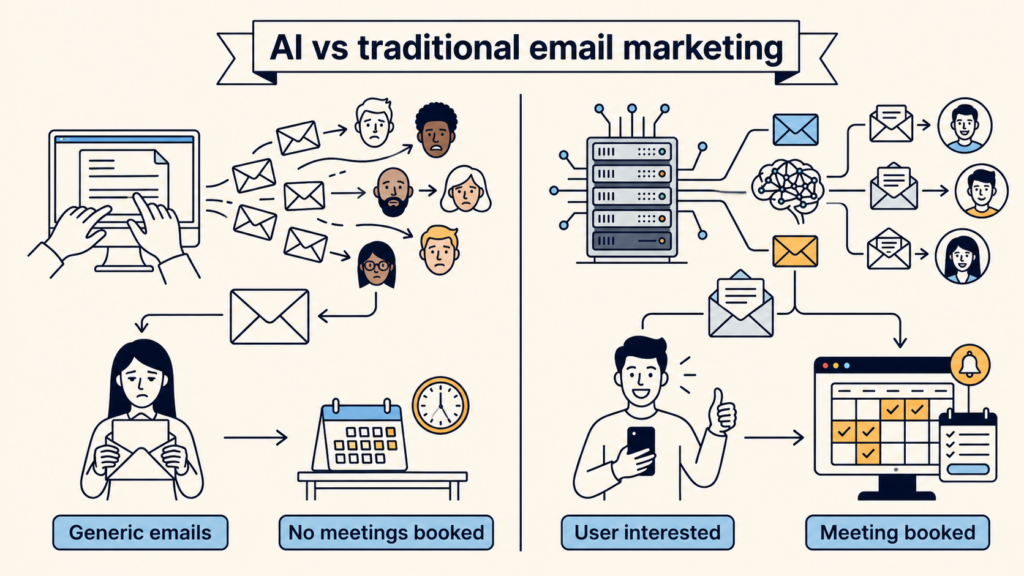
For many decades, traditional outbound email marketing was at the core of B2B sales. The setup begins with the sales reps building a target prospect list. They use email templates and drop in generic placeholders like “Dear {First_Name}”. Finally, sales reps would manually schedule the sequences to be sent to a large list of prospects.
The drawbacks with this approach are many. It typically takes hours for sales reps to manually research prospect accounts, build contact lists/segments, edit email templates, and schedule them. The messaging remains uniform across all recipients, leading to gradual delays in response times.
Modern email service providers have strict spam filters. If you send high volumes of emails with similar, unpersonalized content, they will likely land in the spam folder. This negatively impacts your email domain reputation and your overall campaign performance.
What happens when a prospect shows interest and replies to an email?
The moment that happens, most traditional systems would stop engaging with that prospect. As they are not designed to handle responses, your human sales reps have to step in to carry out conversations.
What is AI-powered email marketing automation?
AI-powered email marketing replaces manual execution and rigid templates with intelligent automation and real-time response handling. Rather than requiring your sales reps to spend hours typing out sequences and triaging replies, modern AI agents execute high-volume, multi-channel outreach. These platforms eliminate the administrative grind and automatically engage with your contacts across email, text, webchat, and phone calls. You can upload a contacts list or sync the AI with your current sales system (eg, HubSpot).
Instead of relying on basic merge tags, the AI uses your company’s sales playbook and knowledge base to craft context-aware body copy, answer incoming questions accurately, and keep conversations moving towards your goal (eg, schedule a demo or book a meeting).
Let’s look at some of the key capabilities of AI outreach automation:
- It coordinates automated follow-up sequences across email, text messages, and phone calls simultaneously without manual rep effort.
- The AI agent leverages your uploaded brand guidelines, product details, and objection-handling rules to ensure every message aligns with your sales strategy.
- It evaluates incoming replies instantly, answering prospect questions using your knowledge base and maintaining natural, two-way dialog.
- It manages back-and-forth scheduling to lock in demos and consultations directly on your sales team’s calendar.
By delegating manual follow-ups, reply handling, and scheduling to an AI SDR , sales development representatives can step away from administrative tasks and focus entirely on attending booked meetings and closing deals.
AI vs traditional email marketing: Key differences for B2B teams
If you’re still wondering, “What difference will it make if I deploy AI agents into my sales systems?”, this comparison will give you clarity.
From execution to tracking, let’s see how traditional email marketing compares against AI in the infographic below:

How does the AI handle an inbound inquiry?
Short answer: the same way it handles outreach based on your sales playbook.
The most vulnerable point in any outreach campaign occurs when a prospect actually replies. In traditional email marketing systems, incoming emails land in a shared inbox where they wait for a human sales rep to take action. Moreover, if a prospect inquires about your product on a Friday afternoon, a delayed reply often means losing them to a competitor.
AI agents are designed to efficiently handle email response management.
Your sales playbook details product information, customer testimonials, FAQs, user response handling procedures, and escalation rules. Based on this knowledge base, the AI instantly responds to a user’s query and leads the conversation to an outcome, for eg, interested.
Modern platforms like an AI SDR allow you to set notification rules. As soon as a contact reaches the ‘interested’ stage, you can enable the AI to notify you via text, call, or email instantly.
Let’s now look at the key advantages of automated inbound response management:
- Instant question answering: Providing precise, technical details about your product or service without waiting for a human sales rep to draft a response.
- Objection resolution: Addressing common buyer hesitations regarding implementation timelines or competitive differences, based on your company’s playbook.
- Direct calendar conversion: Guiding the conversation toward a meeting, sharing availability, and locking in the calendar slot automatically.
By automating email response management, you can remove friction from the buyer journey, ensuring every warm lead receives an immediate response.
The bottom line
AI integration into sales infrastructure is a significant leap in how your B2B sales team builds pipeline and generates revenue. Those who still use traditional systems know well how they struggle under the weight of manual list management and generic templates. Their biggest drawback is delayed reply handling, which often becomes the key reason behind stalled buyer momentum.
In contrast, when you deploy platforms such as an AI SDR, it executes multi-channel sequences across email, text, webchat, and phone. Every outreach message or reply sent to your recipient is aligned with your sales playbook. Integration is as simple as plug-and-play; you can directly upload your contact list or sync with your current CRMs.
By offloading sequence setup, multi-channel touchpoints, customer responses, and meeting logistics to an AI SDR, your revenue teams can scale outbound prospecting without increasing headcount costs. Your sales reps can step away from the time-consuming, manual admin tasks and focus on discovery calls, building genuine relationships, and closing deals.
Upgrading your outreach strategy ensures every prospect receives an immediate, accurate, and engaging response, turning cold contacts into predictable revenue.
Frequently Asked Questions (FAQs)
Traditional email marketing relies on static lists, single-channel templates, and manual schedules to send outbound sales messages to prospects. AI email marketing leverages your company’s sales playbook, multi-channel touchpoints across email, SMS, webchat, and phone, and automated response management to answer questions and schedule meetings directly into calendars.
AI manages prospect replies by analyzing incoming text against your uploaded company playbook, brand voice guidelines, and knowledge base. It sends context-aware answers to buyer questions, addresses their inquiries, and guides them toward booking a demo. When needed, you can enable the AI to route customer inquiries based on your uploaded escalation rules.
No, AI sales emails cannot fully replace human sales representatives. While AI excels at executing multi-channel sequences, answering technical questions via playbooks, and handling meeting logistics, your human sales reps will be essential for strategic deal positioning, building deep trust, and conducting live sales calls to close deals.
Multi-channel execution improves outbound sales by engaging prospects across email, text messages, and phone calls rather than relying solely on saturated email inboxes. Reaching prospects on their preferred communication channels increases response rates, accelerates sales cycles, and improves overall lead conversion.