
Best practices for B2B collections follow-ups (emails, calls & SMS)
 Researched and Written by
  Reviewed and Edited by
 Until your bank account receives the cash, revenue remains a vanity metric for your finance teams. As the gap between sending the first invoice and receiving payment increases, they will experience greater stress and more manual labor. Your company’s cash flow may be crippling because of traditional overdue invoice management, which eventually leads to missed employee salaries and delayed vendor payments. and ruined relationships with vendors and customers.
By implementing B2B collections best practices, you can reduce Days Sales Outstanding (DSO) while maintaining your professional reputation with vendors and customers. This blog highlights some of the highly effective strategies for B2B payment follow-ups, focusing on three channels: Email, phone calls, and SMS.
B2B collections follow-up workflow
The multi-channel approach to B2B payment follow-ups
Most businesses that use traditional invoice management often rely on a single communication channel, for example, email. But they often ignore the biggest risk here. The receiver’s inbox is already overflowing with new emails.
If you only send emails, it will likely become lost in their overcrowded inbox. Let’s say you only call your customer to remind them to pay their overdue amount; you will see them become less cooperative or less active in resolving the current issue.
The key to an effective B2B payment follow-up is to implement a cadence, a planned series of touchpoints across multiple channels, ensuring your message is acknowledged. This creates a sense of professional urgency, prompting the other party to resolve the matter at the earliest.
Emails
Emails still remain the preferred communication channel in the B2B space. All the essential information, including invoices, can be attached to a single email. You can also easily view the entire trail in case you want to refer to past communications.
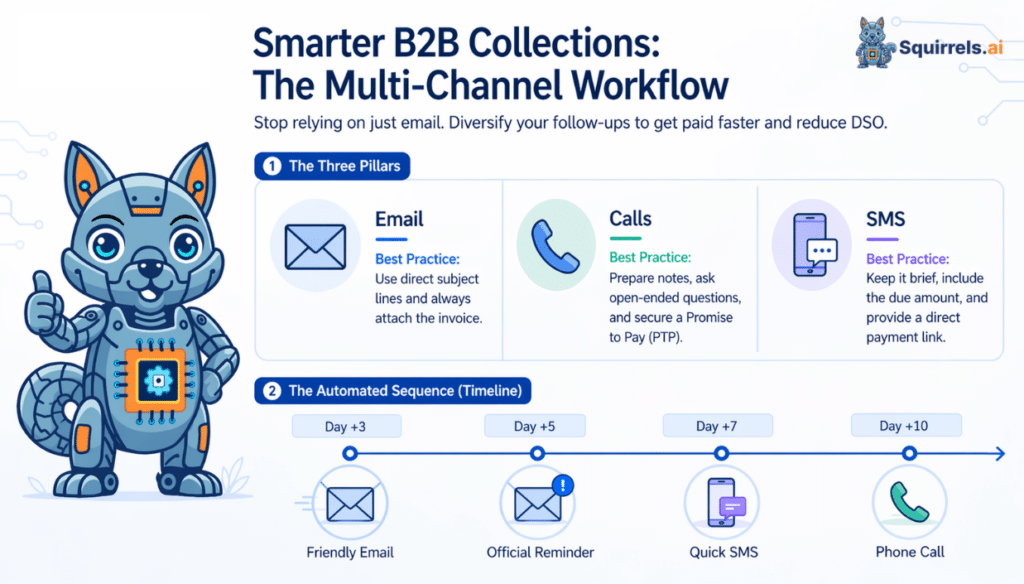
- Be direct in the subject line: Use clear identifiers, like Overdue: Invoice #54321
- Attach the invoice every time: A customer searching for it in the email thread can kill momentum and further delay payment. Make sure to state that you have attached the invoice to the email.
- The escalating tone strategy: The initial email should be a friendly reminder, while subsequent emails should be firm, eventually mentioning potential subscription/credits holds or legal escalations.
Phone calls
When a customer ignores your emails, a phone call becomes necessary. It is harder to ignore a human voice than a virtual notification.
- Preparation is key: Make sure you have all the essential information and notes from past communication ready.
- Ask open-ended questions: Asking ‘Can you pay today?’ often puts pressure on a customer. Instead, ask, ‘When can we expect the funds to be transferred?’ This forces a specific commitment.
- Document everything: Every call should result in a Promise to Pay (PTP) date. Immediately log it into your CRM or accounting software.
SMS
SMSs have gained significant traction in recent years in B2B communication. With open rates above 90%, they can ensure your overdue-payment messages are seen instantly.
- Keep it brief: Text messages must be short, but you must include the amount due and the payment link.
- Timing matters: SMSs should reach the finance team during their work hours, so they can take action promptly.
Why should you implement payment reminder automation?
Your business is growing. You’ll have more customers and vendors to deal with. As that happens, you will find it impossible to follow up with them manually.
In fast-growing companies, finance teams spend up to 40% of their time just manually chasing customers for payments. This is where payment reminder automation becomes a game-changer.
With automated payment reminders, you can create or use playbooks that automatically trigger email/sms/phone calls based on the established sequence. For example:
- Day +3: Automated first overdue reminder email
- Day +5: Automated SMS with a payment link
- Day +7: Automated second firm email with invoice attached
- Day +10: Automated phone call or escalated email to the department head
When you have your outreach automated, you can rest assured that no invoices slip through the cracks. Your human team can also only intervene when a personal touch or a complex negotiation is required.
The challenges of traditional AR collections
Despite following best practices, many companies struggle because of the manual gap.
- Forgetting to follow up on a specific day
- As you add hundreds of customers, you cannot realistically call every single one
- Different team members might use different tones, leading to a fragmented brand experience for the customer.
To bridge this gap, forward-thinking finance departments are moving toward AI-driven collections.
How our AI AR Collections Specialist bridges that gap
If you are looking to master B2B collections best practices without the overhead of a massive team, our AI AR Collections Specialist is your go-to solution.
Our AI agent is designed to act as a tireless extension of your finance department. It is a system trained on your agency’s specific rules and can handle the entire collections process autonomously, resolving disputes and securing payments.
How our AI AR collections agent works:
- Hire & integrate: You hire the AI AR Collections Specialist and integrate it with your existing ERP or accounting software (like QuickBooks, Xero, or NetSuite).
- Sync invoices: Upload your aging list or let the AI automatically sync pending payments.
- Campaign customization: Configure your sequences. The AI will coordinate email, SMS, and phone call sequences so they work in harmony.
- Launch & optimize: It executes the mission, reviews outcomes, and updates payment statuses in real-time, such as promised to pay, disputed, out of office, etc.
The bottom line: Collect faster with zero manual effort
The mission of our AI AR Collections Specialist is simple: improve your cash flow faster with no human effort.
By letting AI handle the repetitive, often uncomfortable task of chasing money, your finance team can shift its focus from collections to high-level financial strategy. You’ll reduce AR aging, eliminate manual errors, and most importantly, get paid what you’re owed.
Ready to transform your cash flow with our AI AR Collections agent?
Book a demo to see how it works.
Frequently Asked Questions (FAQs)
A standard best practice is a 3-5-10 cadence. A common cadence is a first reminder at 3 days past due, a second at 5 days, and an escalated contact at 10 days past due. However, you can also reach out the very next day after the payment is due.
Yes, when used correctly. SMS should be reserved for high-urgency nudges or to provide a quick payment link.
Quite the opposite. Human collections calls can sometimes become emotionally charged. Our AI AR Collections Specialist maintains a persistent, polite, and professional tone at all times.
Our AI agent is designed to work seamlessly with major ERPs and accounting software such as SAP, Oracle, QuickBooks, and Xero to pull overdue contacts.
Typically, if an invoice is 60–90 days overdue and all automated touchpoints have yielded no response or a broken Promise to Pay, it is time to escalate for manual intervention or a specialized AI AR Collections agent.