
Best practices for B2B collections follow-ups (emails, calls & SMS)
 Researched and Written by
 Reviewed and Edited by
Until your business bank account receives the cash, revenue remains a vanity metric for your finance teams. As the gap between sending the invoice and receiving payment increases, they will experience greater stress and more manual labor. Your company’s cash flow may be crippling because of traditional overdue invoice management, which eventually leads to missed employee salaries or delayed vendor payments, and ruined relationships with vendors and customers.
By implementing B2B collections best practices, you can reduce Days Sales Outstanding (DSO) while maintaining your professional reputation with vendors and customers. This blog highlights quick tips for choosing the right channel (email, phone, and text), cadence, handling responses, and escalating continuously delayed payments.
Choose the right communication channel for overdue invoice follow-ups
Blasting reminders is not an ideal way to communicate with customers. Some may ignore email, while some may respond only to phone and text messages. That is why, if you want to use all those channels, you should follow a structured collections process. Various factors can help you select your preferred channel – how old an invoice is, your relationship with the customer, and previous interactions with them.
- Email: Ideal for initial outreach, invoice sharing, and payment confirmations.
- SMS: Works well for quickly following up and communicating upcoming payments.
- Phone call: An excellent addition in later stages of outreach to customers who did not respond to emails and texts. Ideal for high-value overdue invoices and repeated payment delays.
Remember that your goal should be to gently nudge them through the most appropriate channel, rather than blasting generic, identical reminders across every touchpoint.
Establish a consistent payment follow-up cadence
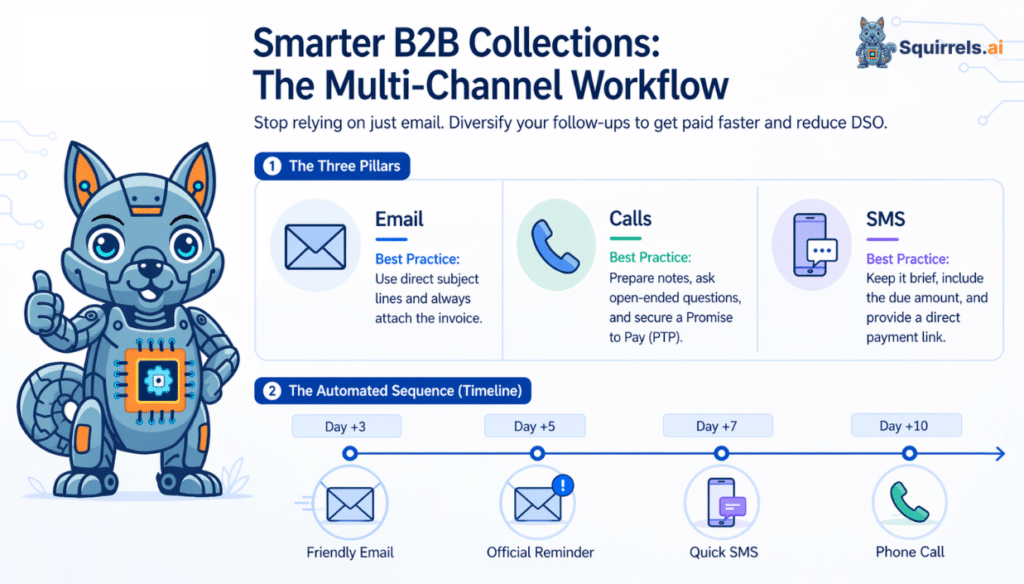
Many AR teams follow up inconsistently. This is one of the biggest mistakes many businesses make. They send a reminder on the due date, then contact the customer again two weeks later. The payment gets delayed due to such gaps.
The best practice is to establish a B2B payment follow-up cadence. Refer to the table below for an example.
| Timeline | Channel | Recommended Action |
|---|---|---|
| 3 days overdue | Send the first overdue payment reminder. | |
| 5 days overdue | SMS | Request a payment commitment and share payment details. |
| 10 days overdue | Phone call | Confirm the invoice status and identify payment blockers. |
| 12 days overdue | Follow up on unresolved issues or missed payment commitments. | |
| 15+ days overdue | Phone call | Initiate a formal escalation based on company policy. |
The above example is illustrative.
Your actual cadence will depend on several factors, including invoice value, previous commitments, and customer payment terms.
You can manually create a cadence when the volume of overdue invoices is low. However, when dealing with large volumes, payment reminder automation makes sense. The best part about automated outreach is that once a customer pays, the system will pause any scheduled reminders, preventing unnecessary follow-ups.
Handle customer responses based on their intent
Customers respond differently to follow-ups. Some mention they will pay soon, while others request additional information or have a query (dispute) about the invoice. Every reminder may not necessarily guarantee a payment.
Every response requires a thoughtful reply, not a random one. Based on the intent of the customer, you should categorize the response and take necessary action.
For example, when a customer promises to pay on Friday, your team should not keep sending daily reminders until that day/date. Instead, pause the follow-up and continue if they miss their payment.
Here are the common types of B2B collection responses and how to handle them.
| Type of Customer Response | Recommended Action |
|---|---|
| Promises to pay on a specific date | Pause the follow-up cadence until the customer pays on the agreed date. Continue sending reminders if you do not receive the payment. |
| Claims payment has already been made | Request transaction details and verify the payment with the finance team. |
| Disputes the invoice amount | Pause follow-up and record ‘disputed’. Also, route the issue to the appropriate team. |
| Requests a copy of the invoice | Immediately share a copy of the invoice. |
| Doesn’t respond | Continue the follow-up cadence until the customer responds. Escalate when necessary. |
Escalate when invoices remain unpaid even after multiple reminders
A bitter truth about B2B invoice collections is that you can not use friendly reminders to resolve every unpaid invoice.
Some customers will repeatedly avoid communicating with you, delay payments, or miss payment commitments.
A structured escalation process becomes mandatory in such situations.
Stage 1: Routine follow-ups
Continue sending reminders as per your cadence. Confirm with the customer that they have received the invoice and that they have all necessary information to clear their invoice.
Stage 2: Internal escalation
If they still have not paid, escalate by involving one of the managers, for instance, the AR manager, account manager, or customer success manager.
Stage 3: Formal escalation
Send a formal email to the customer outlining the unpaid amount, deadline, and the potential consequences of continued non-payment. Clearly mention the consequences as per your contractual terms. These may include suspension of services, restricted usage, or legal action.
Remember that you do not want to pressure the customer to clear their invoice immediately. Instead, you should use an escalation email to resolve overdue payments, protect cash flow, and preserve customer relationships.
Dos and don’ts for B2B collections follow-ups (emails, calls & text)
Emails
Emails still remain the preferred communication channel in the B2B space. All the essential information, including invoices, can be attached to a single email. You can also easily view the entire trail in case you want to refer to past communications.
- Be direct in the subject line: Use clear identifiers, like Overdue: Invoice #54321
- Attach the invoice every time: A customer searching for it in the email thread can kill momentum and further delay payment. Make sure to state that you have attached the invoice to the email.
- The escalating tone strategy: The initial email should be a friendly reminder, while subsequent emails should be firm, eventually mentioning potential subscription/credits holds or legal escalations.
Phone calls
When a customer ignores your emails, a phone call becomes necessary. It is harder to ignore a human voice than a virtual notification.
- Preparation is key: Make sure you have all the essential information and notes from past communication ready.
- Ask open-ended questions: Asking ‘Can you pay today?’ often puts pressure on a customer. Instead, ask, ‘When can we expect the funds to be transferred?’ This forces a specific commitment.
- Document everything: Every call should result in a Promise to Pay (PTP) date. Immediately log it into your ERP, CRM, or Accounting software.
SMS
SMSs have gained significant traction in recent years in B2B communication. With open rates above 90%, they can ensure your overdue-payment messages are seen instantly.
- Keep it brief: Text messages must be short, but you must include the amount due and the payment link.
- Timing matters: SMSs should reach the finance teams during their work hours so they can take action promptly and also to comply with TCPA (Telephone Consumer Protection Act) regulations.
Conclusion
B2B payment collections are not about blasting repetitive, generic reminders or pressuring customers to clear their invoices. Your objective should be to leverage the right medium to reach your customer.
From choosing the right communication channel and establishing a consistent follow-up cadence to handling customer responses and escalating overdue invoices, these B2B collections best practices will help you get payments faster without damaging valuable business relationships.
However, manually handling hundreds of emails, phone calls, and text messages becomes a challenge as invoice volumes grow. This is where many businesses can leverage payment reminder automation.
It brings a huge difference to your collections process. AI agents automate manual, repetitive tasks of sending invoice reminders across multiple channels to help you get paid faster. They autonomously reply to customers’ queries and route complex cases to your designated staff. With AI, your finance team can quickly achieve its goals: reduced DSO, improved cash flow, and faster recovery of overdue payments.
Frequently Asked Questions (FAQs)
The most effective B2B collections best practices include choosing the right communication channel, maintaining a consistent payment follow-up cadence, personalizing reminders, tracking customer responses, and establishing clear escalation rules. You should also maintain accurate invoice records and follow up on payment commitments to reduce overdue balances without damaging customer relationships.
The frequency of B2B payment follow-ups depends on invoice value, payment terms, customer history, and the number of days overdue. A common approach is to send an email reminder 3 days after the due date, follow up through SMS after 5 days, and initiate a phone call after 10 days. However, you should adjust the cadence based on customer responses and payment commitments.
An overdue invoice should be escalated when customers repeatedly miss payment commitments, ignore multiple reminders, or fail to resolve outstanding balances. You can initially involve AR managers or account managers before proceeding with formal escalation. Any service restrictions, credit holds, or legal action should align with contractual terms and applicable laws.
AR automation reduces manual collections work by scheduling and sending payment reminders through email, phone calls, and SMS. It can track invoice statuses, record customer interactions, monitor payment commitments, and trigger follow-ups based on predefined rules. By automating repetitive tasks, you can maintain consistent communication, reduce missed follow-ups, and help your finance team focus on complex collection cases.
Yes. AI agents can identify common customer intents, such as payment promises, invoice copy requests, payment status inquiries, and billing disputes. AI can automatically respond to routine queries, record Promise to Pay (PTP) dates, and update connected business systems. When customers raise complex disputes or request exceptions, the system can route those cases to the appropriate AR team member for resolution.