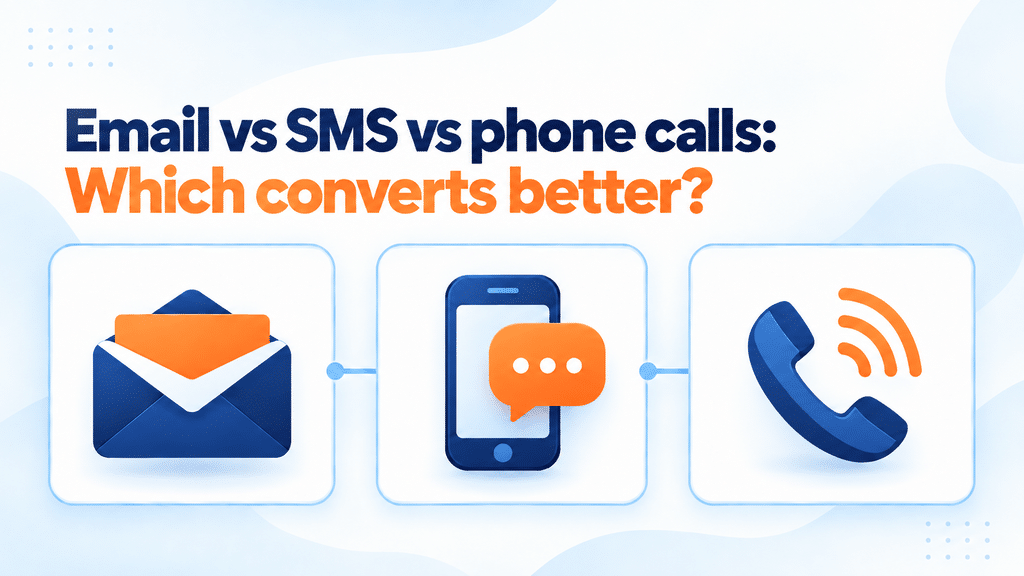
Email vs SMS vs phone calls: Which offers a higher sales conversion?
 Researched and Written by
  Reviewed and Edited by
 A common question asked by many sales and marketing leaders: Should I invest my team’s outreach effort in email marketing, cold calling, or text messaging?
Your customer acquisition costs are rising, and buyer attention spans are shrinking. When you choose the wrong outreach channel, it will likely drain your pipeline.
So, when deciding between email vs SMS vs phone calls, which channel offers a higher conversion?
Instead of being selective, top-performing sales teams leverage multi-channel outreach, where each contributes to bringing a prospect closer to a goal (book a meeting).
Every channel plays a key role: email outreach for scaling and cost-efficiency, text for immediate responses, and phone calls for quick qualified deal closing.
This blog offers a detailed breakdown of how these channels perform and how you can maximize ROI by combining them in your automated outreach.
Email outreach
Email remains the foundation of digital sales and marketing. For B2B organizations, it is still the preferred business communication medium.
- Email allows you to share case studies, ROI calculators, slide decks, and product explainers without character limits.
- Sending 10,000 emails costs roughly the same as sending 100.
- Prospects can read, digest, and forward your message to internal stakeholders on their own timeline.
SMS outreach
Comparing email vs SMS marketing reveals a clear trade-off: email delivers context, but text messaging commands instant attention.
- Text messages bypass crowded email inboxes and rarely encounter spam filters when opted into properly.
- SMS friction is remarkably low. Short links, simple “Yes/No” replies, and automated calendars generate immediate clicks.
Phone call outreach
While some digital marketers label cold calling as outdated, sales veterans know that direct voice conversations remain the fastest way to build human trust and qualify high-value opportunities.
- Live objection handling: On a live call, a skilled representative can clarify questions in real time.
- Instant qualification: You can determine whether a prospect is interested within a 5-minute conversation, rather than waiting days through an email thread.
- Human rapport: Hearing a real voice creates an emotional connection and professional credibility that text cannot match.
Why multi-channel outreach wins every time
An executive might ignore a LinkedIn message, skim a cold email on mobile, decline an unknown phone number, but respond to a text referencing that earlier email.
Combining these touchpoints into an integrated multi-channel outreach campaign grants compounding conversion advantages:
- Increased brand familiarity: When prospects see your name across email, phone, and text, your outreach looks like an established campaign rather than a random cold outreach.
- Higher contact probability: Providing multiple interaction methods allows buyers to respond on their preferred platform.
- Smoother follow-up: A phone call backed by a summary email and an SMS calendar link creates a frictionless prospect experience.

Quick comparison: Conversion benchmarks at a glance
Here is how the three sales prospecting channels stack up across standard benchmarks. Note that the following numbers are derived from our customers using our AI outreach agent for multi-channel prospecting.
| Channel | Average open rate |
Average response rate |
Average sales conversion rates |
Best use case |
|---|---|---|---|---|
| 20% – 28% | 2% – 6% | 1.5% – 3.5% | Detailed value propositions, onboarding, nurture tracks, and scalable prospecting. | |
| SMS | 95% – 98% | 30% – 45% | 8% – 15% | Time-sensitive reminders, quick confirmations, transactional updates, and warm re-engagement. |
| Phone calls | 15% – 25% (connect rate) |
10% – 18% (conversation rate) |
5% – 12% (of connected calls) |
Discovery calls, high-ticket objection handling, relationship building, and closing complex deals. |
Scale your outbound efforts with an AI outreach agent
Executing coordinated cadences across phone, email, and messaging takes hours of manual prospecting, leading to unnecessary friction. That is why we designed a digital outreach assistant. Squirrels.ai offers an AI SDR that handles end-to-end prospecting workflows, such as:
- Autonomous multi-channel execution: It orchestrates personalized cold emails and follow-up messaging at scale.
- Response handling: The AI reads, interprets, and answers prospect objections around the clock, routing qualified buyers directly to your calendar.
- Automated lead qualification: It engages in real, human-like conversations. Based on a caller’s intent, it qualifies leads and adds them directly to your CRM.
- Frictionless outreach: Your human sales reps can stop wasting time on manual data entry and cold drafting, focusing 100% of their energy on closing warm, qualified meetings.
Schedule a FREE demo to see how our AI outreach agent integrates with your company’s CRM and engages with your contacts until they book a meeting/demo or sign up.
Frequently Asked Questions (FAQs)
An AI answering service is an automated voice agent powered by Natural Language Processing (NLP) and Machine Learning (ML). Unlike traditional voicemail, which simply records a message for your busy staff to retrieve later, an AI answering service holds natural, human-like conversations in real time. It instantly answers calls, qualifies caller intents (like bookings or menu inquiries), and directly books reservations without placing customers on hold.
If a customer makes a unique request that falls outside of the AI's pre-trained knowledge base, the system is designed to handle it gracefully. It will recognize its limitations and immediately route the call to a human staff member with the full context of the conversation, ensuring the customer never has to repeat themselves.
During setup, you feed your exact menu, dietary options (such as vegan, gluten-free, or allergen alerts), and restaurant policies into the agent's knowledge base. The AI uses this specific context to answer detailed culinary questions and can seamlessly offer open reservation slots right after resolving the customer's query.
Yes, absolutely! While phone calls are critical during the dinner rush, our AI voice agent is a true multichannel solution. It manages inbound customer inquiries across phone, email, SMS, and website live chat simultaneously. It draws from the same unified knowledge base, ensuring consistent, real-time answers no matter how your guests choose to reach out.
Yes. it connects directly with your existing telephony, CRM, and calendar systems (such as Google Calendar). This allows the AI agent to log caller information, check real-time table availability, and automatically secure bookings within your existing workflows, keeping your data synchronized without manual entry.
You upload your knowledge base, which may include your restaurant's menu, FAQs, policies, and standard processes (your KT documentation). The AI agent trains itself on these specific materials so that every conversation feels natural, context-aware, and perfectly aligned with your brand's unique hospitality style.