AI dental receptionist: Guide for practices
 Researched and Written by
  Reviewed and Edited by
 To ensure your dental practice thrives, you would need to balance clinical care and endless administrative demands.
But if you ask your receptionist how many times they couldn’t answer an incoming call, they’d likely say a couple of times every week.
Calls often get missed when your front desk staff is busy checking in a patient or verifying their documents.
For your dental clinic, every call unanswered means you missed a new patient and revenue.
This is where you can deploy an AI dental receptionist to aid your front desk staff operations. Artificial intelligence infrastructure can help you capture every inbound opportunity, be it in-person or digital channels (call, text, chat, and email).
What is an AI dental receptionist?
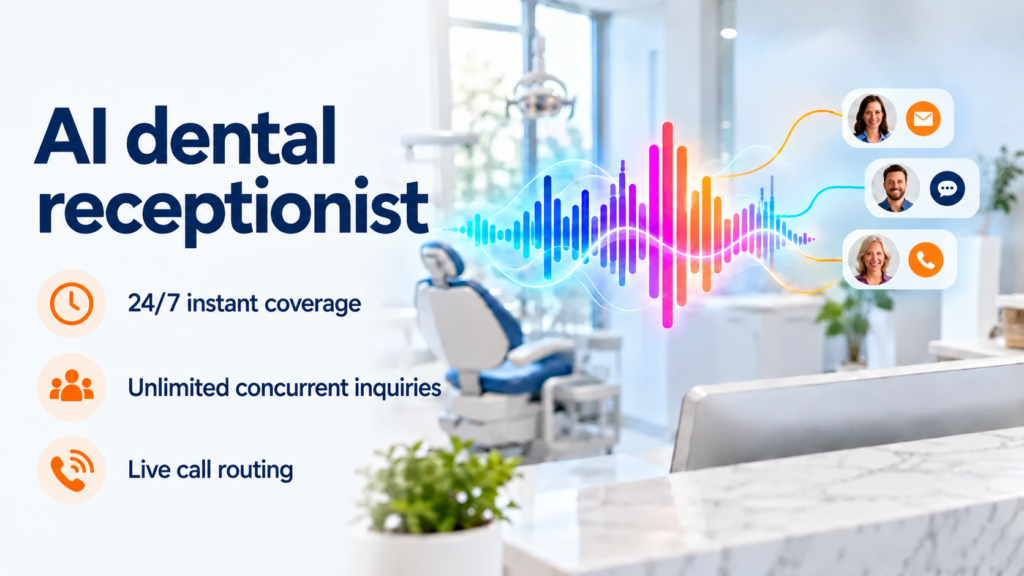
Quick definition: An AI Receptionist is an LLM-based voice agent that offers many capabilities beyond automatically answering inbound inquiries (call, text, email, WhatsApp, and webchat). The software resolves patients’ questions, qualifies leads, books appointments, and can even route urgent calls to your preferred staff.
It works 24*7 alongside your human receptionist, answering inbound inquiries while your staff is occupied with other urgent matters.
You cannot pick up calls while your dental facility is closed. Here, the AI agent provides after-hours coverage by instantly answering an inbound inquiry, eliminating missed opportunities or unnecessary hold times.
It integrates directly with your dental practice management software or Calendar, automatically books appointments, and logs patient records.
The AI dental receptionist also uses natural language processing (NLP) to perform human-like conversations, ensuring callers feel comfortable and engaged.
Why dental practices need dental front desk automation
Your human receptionist often juggles between multiple tasks: patient check-ins, insurance pre-authorizations, and appointment coordination. While doing so, incoming calls may get missed or skipped, leading to lost revenue.
Many clinics have already solved this by using dental front desk automation. Here is how this AI-enabled technology has become an operational necessity for modern clinics:
1. Eliminates after-hours missed calls
Many calls arrive outside standard open hours, such as early mornings, late evenings, weekends, and holidays. These callers end up connecting to a voicemail, eventually hanging up immediately to call the next dentist they find on Google. An AI dental receptionist eliminates this problem and provides coverage for after-hours inquiries instantly.
2. Prevents patient leakage to competitors
Patients calling with severe toothaches or booking routine checkups value immediate answers. If your line is busy or goes to voicemail, they immediately dial another local clinic. Instant call pickup ensures your practice captures every patient inquiry first.
3. Reduces burnout and turnover
Dental receptionists manage heavy workloads, from billing disputes to managing frantic emergency walk-ins. Adding constant phone ringing leads to cognitive overload and staff churn. Offloading high-frequency phone queries lets human staff deliver warm, personalized attention to patients seated in your waiting room.
4. Lowers overhead while increasing production
Hiring additional full-time receptionists to cover extended hours or weekend overflow can be cost-prohibitive. AI automation provides round-the-clock call handling at a fraction of the cost of adding staff, directly protecting your bottom line.
Key capabilities of an AI receptionist for dental offices
Unlike traditional answering services, modern AI receptionists for dental offices offer capabilities beyond generic call answering. They handle multiple administrative tasks simultaneously and accurately.
Appointment scheduling
You can integrate the AI with your Calendar or dental practice management software. The process is a simple plug-and-play and takes only a couple of minutes. It scans your calendar to find available time slots and books appointments based on the caller’s preference. Once booked, you will receive an email confirmation, including essential patient details.
Live call routing
When the AI identifies an emergency or if the caller asks a question it can not answer, it transfers the live call to your human staff based on your dental practice’s protocols. You need to define escalation rules when setting up the AI agent.
Resolving patient questions
A key highlight of modern AI dental receptionists is their ability to resolve common patient questions. You will agree that your front office staff spends significant time listening to and answering identical inquiries, such as:
- “Do you accept Delta Dental or Cigna?”
- “What are your fees for new patient exams and cleanings?”
- “Where are you located and where should I park?”
- “How should I prep before my sedation appointment?”
The AI agent resolves these questions consistently and accurately while referring to your dental clinic’s knowledge base.
Traditional answering services vs. AI dental receptionist: A side-by-side comparison
Modern AI voice agents are designed to assist your staff, not replace them. They act as your digital co-pilot, taking over manual, repetitive tasks once you deploy them. Imagine the hours you get back, allowing you to focus on high-value tasks. The table below shows the major differences between an AI dental receptionist and a traditional answering service.

How to implement dental front desk automation in your clinic
Automating your dental clinic’s front desk does not require overhauling your entire workflow. However, you need to go through a few basic steps as follows:
- Set up knowledge base: You train the AI using your dental clinic’s KT document, FAQs, and policies. It will utilize your uploaded knowledge base when answering and resolving inbound inquiries.
- Set goal & define routing: Set the AI to resolve inquiries, schedule appointments, and route calls to staff. Ensure that you map points of contact, departments, and escalation rules for accuracy.
- Configure channels & booking: The AI dental receptionist becomes your facility’s first point of contact. Configure where you want it to operate – phone, email, SMS, or web chat. Connect your calendar for scheduling meetings.
- Launch & optimize your setup: Review handled inquiries and routing accuracy, and take manual action as needed.
Never miss a customer with an AI dental receptionist
If your dental practice has been dealing with a growing number of missed patient calls and wants to automate appointment booking, deploying an AI agent will be an ideal step. Squirrels.ai offers AI agents for business automation, eliminating the need for increasing headcount.
We designed our AI Receptionist to handle your entire front-desk workflow: answer inbound inquiries across multiple channels (phone, email, text, and webchat), resolve patients’ questions from your knowledge base, route live calls to the right staff or department, and book meetings directly into your calendar.
The AI uses NLP to understand a caller’s intent and respond with human-like conversation. Whether it is early morning or late at night, it provides after-hours coverage and handles inbound communications with ease.
Our AI dental receptionist is ideal for solo general practices, pediatric clinics, and multi-location DSOs. No matter what practice you operate, our AI agent will help you scale effortlessly with your patient volume.
The setup takes just 5 minutes. Eager to see how? Book a FREE demo with Squirrels.ai
Frequently Asked Questions (FAQs)
Yes. It integrates smoothly with major scheduling systems, calendar tools, and CRMs. It reads real-time provider availability to book, reschedule, or cancel patient appointments without double-booking chairs.
You can configure customized emergency triage rules. When a caller mentions severe swelling, bleeding, trauma, or severe pain, the AI agent identifies the urgency, gathers critical details, and either transfers the call to your on-call clinician or sends an instant notification.
The AI software uses ultra-low latency, human-grade voice synthesis with natural pacing, conversational tone, and polite speech patterns. While callers experience a smooth, human-like interaction, we recommend maintaining transparency by letting patients know an automated assistant is helping them quickly.
Yes. Unlike traditional telephone lines or single staff members, front desk automation handles unlimited concurrent calls. Even during Monday morning surges or marketing campaign spikes, zero patients are placed on hold.
Setup is fast, it takes barely five minutes. Most practices can customize their clinic knowledge base, configure voice parameters, map call routing rules, and go live, all without needing dedicated IT or engineering support.