
How to handle overdue invoices without losing clients

 Researched and Written by
  Reviewed and Edited by
 Unpaid bills are among the biggest hurdles to maintaining a balance between healthy cash flow and high-quality service delivery. To run a successful business and achieve sustainable growth, you must know how to handle overdue invoices without damaging professional relationships with your clients.
A client missing a payment deadline often leads to anxiety and frustration. When instances of late payment increase, you might become carried away by these emotions and turn slightly aggressive when communicating with clients. Of course, securing the hard-earned capital might be a top priority for you, but you also do not want to alienate a client who might bring in more projects in the future.
You must remember that when a client pays your invoice late, they are not doing so deliberately to hurt your business. Common reasons include lost emails, admin oversight, or temporary financial adjustments on the client side. Hence, it is important to know how to deal with late payments with professionalism and empathy. You can also implement modern late-payment solutions, such as an AI AR collection specialist, to significantly reduce the time required to collect your outstanding invoices while keeping client relationships completely intact.
A structured system for Accounts Receivable
Before you send an aggressive late-payment reminder, take a moment to understand why the customer delayed it. You will notice the dynamics shift completely when you approach the situation calmly and collaboratively. You may feel uncomfortable after repetitively chasing customers to get them to clear their invoices. But remember that reminding compensation for services rendered is a standard practice in any business. Following this healthy perspective can help you secure business revenue without feeling guilty or sounding aggressive.
If you want to handle overdue invoices without losing clients, the most effective approach is to implement a structured system or use automated late-payment solutions. Both of these overdue invoice management strategies can allow you to approach every client professionally and consistently.
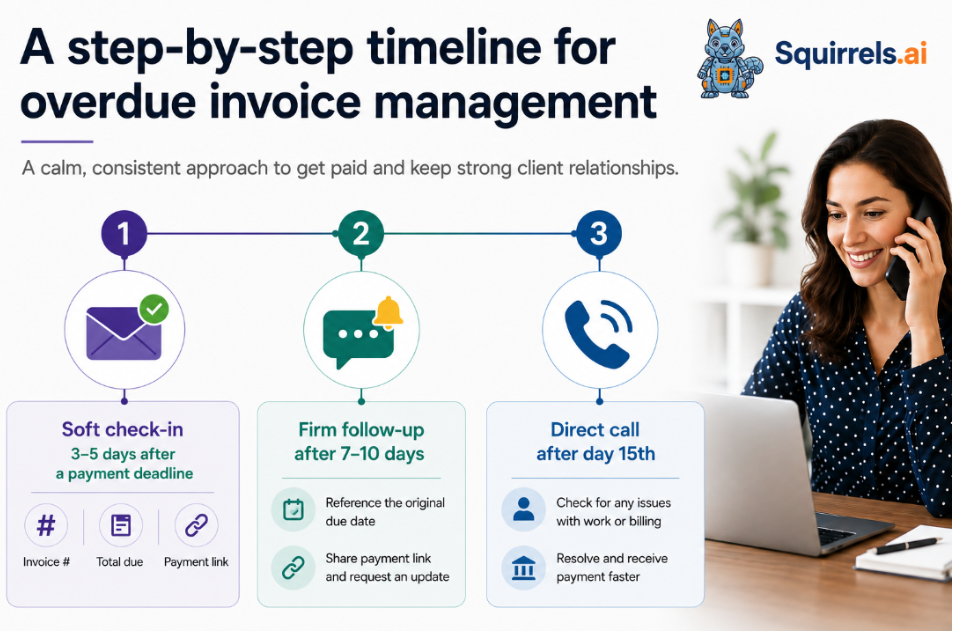
Soft check-in 3-5 days after a payment deadline
One of the most effective payment collection tips is to avoid sending the first reminder on the day the payment is due. That could annoy customers, as they may be in the middle of processing it. 3-5 days after the due date, send a brief, gentle reminder, preferably an email. The initial message should be casual and convey a friendly tone. Ensure that the email reminder includes the invoice number, the outstanding total due, and the payment link. Including the invoice number and total amount in the subject line will increase the likelihood that the customer notices and opens it. However, your email may also end up in the customer’s spam folder.
Firm follow-up after 7-10 days
You’ve already sent the first reminder 7-10 days ago, but the customer has not paid their overdue invoice. In fact, there is no response from them. Did it land in their spam, or did it get lost in a huge pile of unread emails? The more you think, the more stressed and frustrated you will become.
It’s time for a second reminder, keeping the tone slightly escalated, direct, but polite. This time, you can send an SMS that clearly states the original due date and the payment link. You can also request an update on when the customer can expect to have the funds cleared.
Direct call after day 15th
If your written communications go unanswered for two weeks, call the customer directly. One payment collection tip is to avoid sounding like you are blaming or accusing them of ignoring your previous reminders. Instead, say the reason for this call is that you are tracking outstanding balances for the quarter and want to ensure there are no issues with the completed work or the billing details. Often, a brief phone conversation can resolve miscommunications instantly and result in an immediate credit card or bank transfer payment.
Proactive payment collection tips to prevent future delays
The best way to deal with late payments is to prevent them from happening in the first place. By adjusting your onboarding processes and billing terms, you can significantly lower the risk of outstanding balances.
- Establish clear terms from the beginning: Never start a project without an explicit, signed agreement that details your financial terms. Whether you require payment within fifteen days, thirty days, or upon receipt, ensure your client understands these expectations before work commences.
- Request upfront deposits or milestones: For long-term projects or high-value contracts, do not wait until the very end to bill for your services. Requesting a percentage of the total fee upfront protects your cash flow and ensures the client has financial skin in the game. Breaking down the remaining balance into smaller milestone payments keeps revenue flowing steadily.
- Offer flexible payment methods: The more difficult it is for a client to pay you, the longer they will delay. If you only accept paper checks, you are limiting your collection speed. Provide modern options such as credit card processing, digital wallets, and automated clearing house transfers. Adding a direct payment link to your electronic invoices makes the process seamless for the client.
Modern late payment solutions and automation
The above late-payment collection tips work well when you have only a handful of outstanding balances. But as your organization grows, so will your customer size. Manually reaching out to customers will consume a significant amount of valuable hours, and only a small percentage of them will clear their invoices after numerous follow-ups.
So, we come back to the same question, “How do I handle overdue invoices?”
Here, you can leverage automated late payment solutions designed specifically for managing AR collections at scale with zero manual work.
These AI agents reduce the administrative friction, streamlining your notification process. They allow you to schedule your automatic payment reminders across email, SMS, and phone calls after the invoice due date. AI AR collection specialists also eliminate the awkwardness and aggressiveness associated with chasing clients for outstanding money.
Say goodbye to manual collections with Squirrels AI
If you are ready to collect outstanding payments faster with zero manual effort, it is time to transform your accounts receivable workflow. At Squirrels AI, we have engineered our AI AR Collections Specialist to eliminate the friction of chasing unpaid bills.
Our autonomous agent seamlessly integrates with your existing ERP and accounting software to improve your cash flow faster with no human effort. Your finance department instantly transitions into an optimized collections powerhouse, dramatically reducing accounts receivable aging.
How the autonomous collections agent works
Deploying your digital collections team takes only a few simple steps:
- Hire the agent and set up the process: Activate your AI AR collections agent and establish your corporate collections playbook.
- Set goals and add overdue invoices: Define your primary goals, then upload your aging list or sync data directly from your accounting software.
- Customize the outreach campaign: Configure multi-channel email, SMS, and phone call sequences, then run a quick dry run to ensure perfect alignment.
- Launch and optimize: Let the agent execute its mission while you review real-time outcomes and payment status updates.
Key capabilities of the AI AR Collections Specialist
Our intelligent agent engages your customers across multiple channels with polite, persistent, and timely notifications until your balances are fully settled:
- Payment reminder emails: The system automatically summarizes outstanding balances, due dates, and payment instructions. It sends courteous follow-up emails that dynamically escalate in tone if invoices remain unaddressed.
- Context-driven calls: The agent handles automated phone calls to remind clients of overdue invoices while directly referencing previous emails. It engages in natural, context-aware conversations to encourage immediate payment commitments.
- Engaging text messages: Short, effective SMS reminders are deployed straight to your client’s mobile device. The AI manages incoming replies, instantly provides direct payment links, and confirms when an action has been successfully taken.
Book a demo to learn how our technology can help you secure your revenue while you focus on scaling your business operations.
Frequently Asked Questions (FAQs)
You can handle overdue invoices professionally by assuming good faith, keeping communications objective and polite, and avoiding accusatory language. You must clearly reference the invoice details and balance, and include direct, digital payment links within every reminder to remove friction and encourage a fast resolution.
The best approach is a structured, multi-channel cadence that escalates gently. Start with polite emails and the attached invoice during the first two weeks. Follow up with a friendly phone call, then escalate to formal written letters or text alerts if unpaid for weeks.
Preserve relationships by positioning yourself as a problem-solving partner. Offer flexible payment plans to break large balances into manageable installments, and substitute cold email sequences with friendly, empathetic phone calls to understand the client's situation and collaborate on a solution.
Protect cash flow by securing upfront deposits or milestone payments of twenty-five to fifty percent before beginning projects. Additionally, include clear late fee clauses in contracts to incentivize timely payments, which can be waived later as a gesture of goodwill.
Automation eliminates the awkwardness and administrative burden of chasing money. Software ensures objective reminders are sent reliably on a set schedule, keeping invoices at the top of a client’s inbox, reducing Days Sales Outstanding, and speeding up payouts without straining relationships.