5 best AI agents for business automation 2026
 Researched and Written by
  Reviewed and Edited by
 When your highly skilled professionals spend their mornings copying customer data from a CRM into traditional spreadsheets, your payroll capital is being wasted.
You hired brilliant minds to close deals. Instead, they are stuck doing the repetitive, manual tasks because the department is understaffed.
This is a classic example of a business bogged down in traditional workflows.
Today, businesses increasingly leverage AI agents into their infrastructure. They are stacking task-specific agents that handle end-to-end, repetitive tasks.
If evaluating a dozen AI automation tools has left you wondering, “What are the best AI agents for business automation?”, this blog will help you cut through the noise.
It breaks down five AI agents that can help you free your human leaders to focus on high-level strategies. I’ll show you what each tool is best for, how to integrate them into your infrastructure, and the value you can get from them.
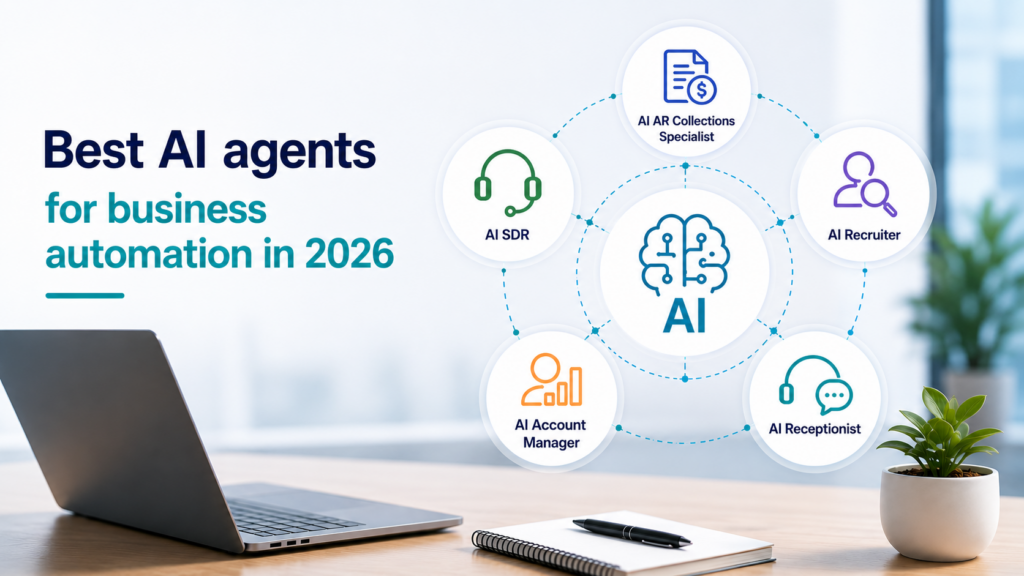
The 2026 digital workforce: AI agents automating business tasks

AI Accounts Receivable (AR) Collections Agent
The AI AR collections specialist is a must-have tool for finance teams looking for the best AI agents for business automation. When your company grows, so will your customer base. Your finance department will have to deal with large volumes of outstanding invoices. This leads to employee burnout, strained client relationships, and delayed cash flow.
An AI AR Collections agent solves this operational bottleneck by automating reminders and follow-ups for overdue invoices. It integrates with your existing tools, such as NetSuite, SAP, or QuickBooks. The AI will pull contacts from your AR aging list and start engaging with them.
Most traditional automation tools rely on generic, rigid templates. The AI AR collections agent drafts email, text, and voice scripts based on your company’s collections playbook. Each message contains essential payment information, including invoice number, date, and payment link. It performs a coordinated, multi-channel outreach consisting of emails, text, and phone calls. As the AI engages with contacts, it assigns a status, such as paid, promised to pay, or disputed, based on their response. You can track status in real time and also at the end of the outreach sequence. With the agent, you collect overdue payments faster, without expanding your finance team’s headcount.
AI SDR (Sales Development Representative)
If you have been looking for the best AI agent for business automation to handle sales pipeline development, the AI SDR is exactly what you need.
Based on your company’s sales playbook, the AI SDR agent sends customized emails, text SMSs, and makes phone calls, managing high-volume sales prospecting. Most traditional sales automation tools sound generic and robotic. The AI SDR agent reads a prospect’s inquiry and responds with human-like, detailed messaging in real time.
Many businesses also leverage AI SDR for inbound communications. This ensures no prospect slips through the cracks and gets a timely response. Whether your goal is to book meetings or sign up, the artificial intelligence agent will engage prospects until it achieves the goal.
With AI SDR software, you can reduce the cost and time required to get new customers. Consequently, your human sales reps can shift their focus to high-value activities like running discovery calls, designing account strategies, and closing deals.
AI Recruiter
In this fast-moving hiring market, organizations pursue top talent aggressively and hire quickly. But securing the best talent requires immense speed and coordination. This often multiplies when you have many job openings.
AI workflow automation tools, such as the AI Recruiter, can engage with your pool of qualified candidates at scale. It executes the entire outreach, effortlessly handling the repetitive follow-ups and scheduling.
Think of it like an automatic, round-the-clock talent-sourcing engine. It reaches out to a vast database of candidates via emails, text, and phone calls. It answers their questions about the role and keeps interest high until they apply or book a meeting with your human recruiter.
One of the key features of an AI Recruiter is that it seamlessly integrates with most modern ATS and HR software like JobDiva, Oorwin, and more.
AI Account Manager
Most top-tier accounts get the closest attention from human account managers. This leaves them with less time to manage low-to-mid-tier clients. Eventually, it leads to higher churn risks and lower retention rates.
An AI Account Manager, our fourth AI agent for business automation on this list, manages the end-to-end process of nurturing and retaining clients at scale. It automatically provides account updates, collects feedback, and responds to their inquiries. By handling proactive follow-ups, it strips away the admin burden that often slows your team.
Integrating an AI Account Manager into your system offers a massive upgrade to your team’s current bandwidth. They can handle more than a hundred clients simultaneously with the same attention they previously gave to only 10 accounts. This allows your human SDRs to pivot to high-value enterprise accounts.
AI Receptionist
Many small businesses struggle to manage their front support desk due to limited resources and basic call-handling capabilities. Because they rely on traditional, manual processes, callers usually hang up or leave voicemails. This setup also leaves them with barely any off-hours or weekend support. Customers who call in for urgencies have no way to receive immediate assistance. They lose potential customers to their competitors.
Deploying an AI receptionist directly addresses these resource constraints by automating the entire inbound call workflow. Available 24/7, the AI agent can instantly answer customer queries, log requests, and provide immediate support during nights and weekends without requiring extra staff. By replacing outdated voicemail systems with responsive, round-the-clock automation, businesses can eliminate manual callback backlogs, safeguard customer loyalty, and scale their operations seamlessly.
Driving strategic growth through digital workforce deployment
The transition towards AI agents for workflow automation also reveals how businesses are realigning their infrastructure design. Corporate leaders not only want to reduce operational costs, but also set their top-tier talent completely free from repetitive, manual task execution. Intelligent automation eliminates administrative friction, allowing your leadership to focus entirely on scaling and relationship building.
Squirrels.ai is one such platform that makes it easy for businesses to deploy digital workers into their current workflows. Whether it is the AI AR Collections Specialist or the AI Reminder, each autonomous agent works just like your human team member. You can train each AI agent simply by uploading your company’s playbook, including SOPs, brand voice, or any other knowledge material.
Our platform will integrate with your existing software stack, including CRMs, HR tools, and accounting systems. It pulls contacts and manages outbound and inbound workflows autonomously across voice calls, emails, and SMS.
Get started for free with no credit card required, or book a demo to see how Squirrels.ai performs with your existing stack.
Frequently Asked Questions (FAQs)
AI agents for business automation are autonomous software entities powered by generative AI and advanced language models. Unlike basic software, these agents can understand context, make decisions, interpret unstructured human communication, and execute multi-step workflows. They operate across communication channels like email, phone, and SMS to perform complex professional roles independently.
AI agents automate workflows by directly integrating with corporate databases, CRMs, and communication systems via APIs. They monitor operational triggers, read inbound customer queries, analyze context, and execute necessary actions. By shifting workflows from static logic to intelligent decision-making, they handle complex tasks like lead qualification and payment collection without manual intervention.
Yes, AI agents provide far superior flexibility compared to traditional rule-based software or standard robotic process automation. Traditional tools break easily whenever formats, fields, or user interfaces alter slightly. AI agents read and comprehend unstructured information like human beings, adapting naturally to unexpected conversational changes or process variations without requiring constant reprogramming.
Absolutely. AI agents are highly accessible to small and mid-sized enterprises because they require minimal engineering infrastructure to deploy. Smaller companies can connect pre-trained digital workers to their current software setups, gaining enterprise-scale capabilities in sales, recruitment, and customer success without the financial burden of expanding human headcounts.
Begin by identifying your highest-friction operational bottlenecks, such as slow collections, dropping lead response rates, or delayed candidate screening. Review specialized agents built for those specific functional areas, ensuring the chosen AI platform offers native API integrations with your existing tools alongside multi-channel communication capabilities across phone, text, and email.