
AI lead generation: How it works, benefits & strategies
 Researched and Written by
 Reviewed and Edited by
Top three things your sales team spends more time on that they can afford: finding genuinely interested prospects, reaching the decision makers, and consistently following up.
While these are essential for generating leads, manual research and prospecting can become increasingly difficult as your business grows.
AI lead generation helps overcome this challenge by automating the manual, repetitive tasks, allowing your sales team to quickly attract and engage with prospects.
But how does AI generate leads?
Can businesses build a consistent sales pipeline with it?
This blog explains how AI lead generation works, its benefits, practical strategies, and how businesses can implement it effectively.
What is AI lead generation?
When you use artificial intelligence to identify, attract, qualify, and engage prospects for your product or service, that entire process is called AI lead generation.
These AI platforms combine advanced technologies, such as natural language processing (NLP) and machine learning. With AI, your sales team can automate and improve lead-generation efficiency.
Sales reps spend a big chunk of their time analyzing datasets, checking buying intent, prioritizing potential customers, and communicating with them.
Artificial intelligence goes beyond traditional methods and handles all these activities autonomously and effortlessly.
For example, if you’re an owner of a B2B FinTech company in the US, you can use AI to match prospects relevant to your ideal customer profile (ICP) and initiate autonomous outreach.
Trouble having qualifying leads or answering repetitive questions?
Modern AI sales representatives answer common questions, qualify leads, and book demos based on your sales playbook.
This way, the AI handles the grunt work, letting your sales reps focus on closing deals and building customer relationships.
How does it work?
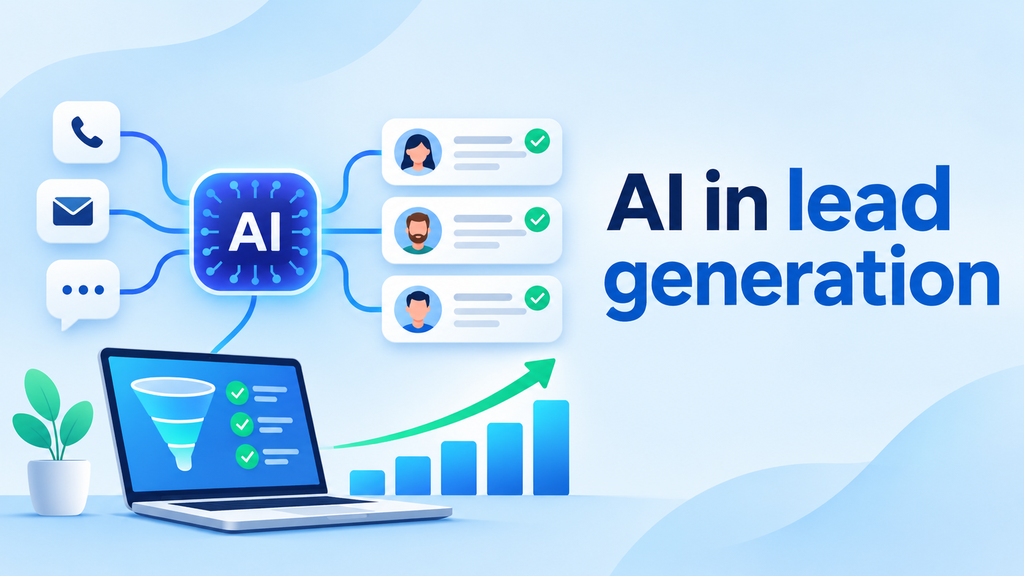
To move prospects through your sales pipeline, AI lead generation combines data analysis, intelligent automation, and customer engagement.
1. Identifies prospects
Based on your ICP, the AI gathers essential information about a company, industry data, and other relevant signals to identify potential customers.
For B2B companies, this might involve finding organizations that recently raised funding, expanded operations, or hired new executives.
2. Lead enrichment and scoring
After identifying prospects, it enriches their profiles with relevant company and contact information. The AI scores prospects based on their buying intention, company size, industry, etc. Lead scoring helps businesses prioritize leads closest to the conversion stage.
3. Personalized outreach and qualification
The AI agent curates tailored scripts and initiates outreach across communication channels, including email, phone, text, and WhatsApp. It uses NLP to understand a prospect’s response and intent, ask qualifying questions, handle queries, and book demos and meetings.
4. CRM updates and sales handoff
The AI routes qualified leads to your sales reps with full context, including conversation transcripts, recordings, and summaries. If a prospect mentions something important over the phone, the sales rep can take note of it before joining the demo. This way, no time gets wasted, allowing your sales team to focus on converting prospects into customers.
What are the benefits of AI for lead generation?

AI offers several advantages over manual prospecting and traditional lead generation automation.
Faster prospecting
Sales representatives often spend hours researching companies, identifying decision-makers, and preparing contact lists.
AI can accelerate these activities by processing information and identifying relevant prospects at scale.
Improved lead quality
AI-driven lead scoring helps businesses prioritize prospects based on fit and intent rather than treating every contact equally.
However, the accuracy of these predictions depends on the quality of the underlying data.
Personalized engagement at scale
Instead of sending identical messages to hundreds of contacts, AI can tailor communication using relevant prospect information.
This makes outreach more contextual without requiring representatives to manually write every message.
Consistent follow-ups
Potential customers may not respond to the first interaction. Automated lead generation workflows can schedule follow-ups and adjust subsequent communication based on responses.
This helps prevent promising opportunities from being forgotten.
Reduced operational workload
By automating research, initial conversations, qualification, and CRM updates, businesses can free sales representatives to focus on relationship building, product demonstrations, and closing deals.
6 AI lead generation strategies for B2B businesses
Implementing AI successfully requires more than purchasing a lead generation platform. Your business needs a clear strategy for finding, engaging, and converting the right prospects.
1. Define your ideal customer profile
Start by identifying the characteristics of businesses most likely to purchase your product or service.
Consider industry, company size, location, revenue, technology stack, and common business challenges.
A clearly defined ICP helps AI systems conduct targeted lead generation instead of producing large volumes of irrelevant contacts.
2. Use intent signals to prioritize prospects
Not every company matching your ICP is ready to buy.
AI can analyze signals such as website engagement, relevant content consumption, hiring activity, and company announcements to identify potential buying interest.
These signals are indicators, not proof of purchase intent. Combining them with qualification criteria creates a more reliable approach.
3. Automate inbound lead qualification
Website visitors, form submissions, and incoming calls can represent valuable opportunities.
AI agents can engage prospects immediately, answer common questions, collect contact information, and determine whether they meet qualification requirements.
For example, an AI receptionist can handle an inquiry outside business hours and schedule a consultation without waiting for an employee to become available.
4. Build multichannel outreach workflows
Relying exclusively on email can limit engagement opportunities.
Businesses can combine email, phone calls, SMS, and web chat to reach prospects through appropriate channels.
AI can help coordinate these interactions, maintain conversation context, and trigger follow-ups at scale.
Communication preferences, consent requirements, and applicable outreach regulations should guide channel selection.
5. Identify key decision-makers
Effective B2B lead generation requires reaching people who influence purchasing decisions.
AI can help identify relevant job titles, departments, and organizational relationships within target accounts.
For instance, a company selling recruitment software might target talent acquisition managers, HR directors, and operations leaders rather than contacting employees indiscriminately.
6. Continuously optimize the lead generation funnel
An AI-powered lead generation funnel should be monitored from initial prospect identification to sales conversion.
Track which sources produce qualified leads, which messages generate meaningful conversations, and where prospects drop off.
Use these insights to refine targeting criteria, qualification questions, and outreach workflows.
Traditional vs. AI-powered lead generation
Capability | Traditional lead generation | AI lead generation |
Prospect research | Primarily manual | AI-assisted identification |
Lead scoring | Manual or rule-based | AI-assisted |
Personalization | Written individually or from templates | Context-aware message generation |
Follow-ups | Rep-managed or scheduled | Automated and response-driven |
Lead qualification | Human-led | AI-assisted conversations |
Scalability | Often requires more staff | Handles high volumes |
AI does not eliminate the need for sales professionals. It changes where they spend their time.
How to implement AI lead generation in your business
Businesses can begin with a focused implementation rather than automating their entire sales process immediately.
- Identify repetitive tasks: Determine whether prospect research, lead qualification, outreach, or follow-ups consume the most resources.
- Establish qualification criteria: Define what makes a lead worth pursuing, including budget, authority, need, and purchasing timeline where relevant.
- Choose appropriate AI capabilities: Evaluate lead generation platforms based on data quality, communication channels, CRM integrations, and automation requirements.
- Launch a controlled pilot: Start with one customer segment or lead source. Review AI-generated messages and qualification decisions before expanding.
- Measure business outcomes: Track qualified leads, meetings booked, lead-to-opportunity conversion rates, cost per qualified lead, and pipeline generated.
For businesses managing large volumes of inbound and outbound conversations, AI sales development agents can extend automation beyond lead discovery.
For example, Squirrels.ai’s AI SDR supports automated sales communication across voice, SMS, email, and web chat, helping businesses engage and qualify prospects while reducing repetitive manual work.
Conclusion
AI lead generation helps businesses move from manual prospecting and inconsistent follow-ups toward a more structured, scalable sales process.
Its greatest value comes from combining accurate prospect data, intelligent qualification, personalized engagement, and timely sales handoffs.
Businesses that start with clear targeting criteria, measure qualified opportunities rather than raw lead volume, and retain human oversight will be better positioned to turn AI-powered lead generation into sustainable pipeline growth.
Frequently Asked Questions (FAQs)
Yes. AI can identify prospects, enrich contact information, score leads, and automate initial outreach. Some AI agents can also qualify prospects and schedule meetings. However, automation capabilities vary by platform.
Yes. Small businesses can use AI to respond to inquiries, qualify prospects, and automate follow-ups without expanding their sales teams proportionally. The right approach depends on lead volume, budget, and existing processes.
Lead generation focuses on identifying and attracting potential customers. Lead nurturing focuses on developing relationships with those prospects until they are ready for a sales conversation. AI can support both activities.
AI can automate many repetitive responsibilities performed by lead generation specialists, including research, initial outreach, and qualification. Your staff remains valuable for strategy, relationship management, complex conversations, and sales decisions.