What is IVR? How it works and where AI fits in
 Researched and Written by
 Reviewed and Edited by
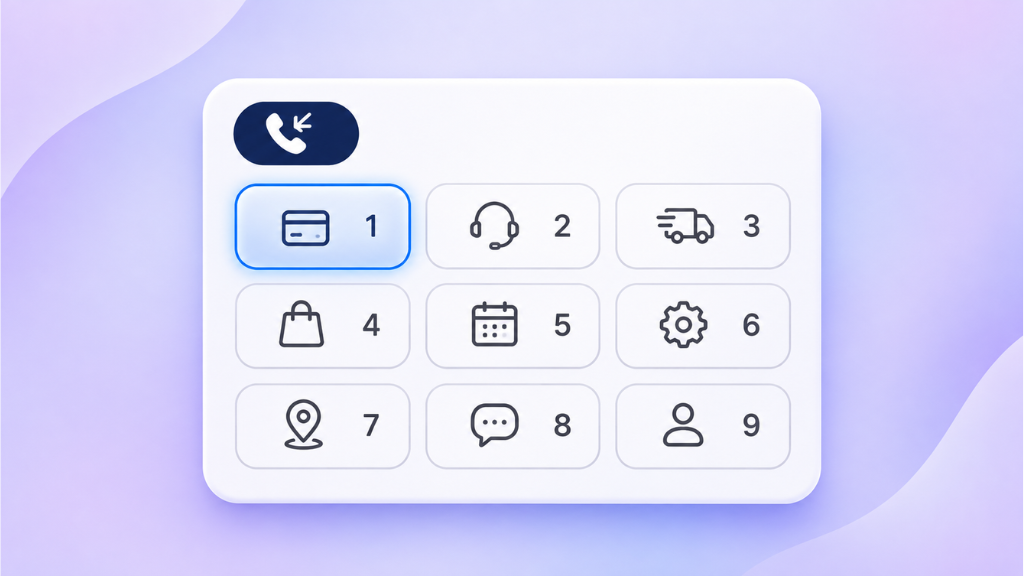
Press 1 for sales, 3 for subscription billing, or 5 for support, and chances are you’ve pressed ‘end call,’ feeling enraged. That is a classic example of Interactive Voice Response (IVR). Businesses use this conditional branching system to handle incoming calls. IVR directs callers to the concerned department and helps complete routine requests.
But what happens when a caller’s request doesn’t fit into predefined options?
Natural language understanding and artificial intelligence (AI) are having a meaningful impact on IVR, with better self-service options. We’ll discuss that briefly in this article, along with how IVR works, its different types, benefits, and limitations.
What is interactive voice response (IVR)?
Interactive voice response (IVR) is an automated technology that enables a business’s phone system to interact with callers. The system determines what happens next based on the keypad selections or spoken commands.
IVR systems are widely known for routing calls; however, they can also retrieve information from automated responses. Let’s say you call a bank’s customer care number. Using your phone number and responses, the IVR system can retrieve your bank account information and communicate your account balance before transferring you to a customer care representative.
How does an IVR system work?
An IVR system gathers caller input(s), processes it against configured workflows, and decides the appropriate response. Let’s start with;
1. Collecting caller inputs
The caller will respond to the automated greeting menu using their keypad selections. The IVR system captures these selections through dual-tone multi-frequency (DTMF) signals. Speech-enabled IVR systems use speech recognition to gather inputs.
2. Processing the inputs
Then, the caller’s input is evaluated against predefined business rules. Depending on the input, the IVR system may present additional options or retrieve data.
3. Responding to the request
After evaluating the inputs, the system tries to handle the request. If the system cannot resolve the request, it routes the caller to the concerned department (for instance, customer support).
What are the different types of IVR systems?
IVR systems differ depending on how businesses want to receive input. Some businesses use keypad menus, while some businesses use speech-based commands. The infographic below depicts how these approaches differ.

IVR is more than just fixed phone menus. Speech recognition and conversational AI IVR offer additional capabilities to handle caller requests. But that doesn’t make traditional phone IVR systems irrelevant. Some businesses combine all three to balance the level of support their customers need.
Why do businesses use IVR systems?
Manually handling every incoming call becomes difficult. IVR helps businesses automate predictable interactions and delegate human assistance to interactions that need attention. Businesses use IVR systems to:
Handle high call volumes
IVR systems are adept at handling multiple calls. This directly addresses the pain point businesses face when handling multiple manual calls. Requests requiring human assistance would be routed to available support teams.
Provide 24/7 self-service
Customers call whenever they want information. A 2022 YouGov survey found that 45% of customers across 18 markets said 24/7 access to a customer service agent would make them more likely to work with a brand. The after-hours IVR system isn’t a replacement for human support. But it can handle routine requests outside business hours.
Improve call routing
Misrouted calls waste employees’ energy when handling irate customers. The IVR system understands what the customer wants through automated inputs. Based on the input received, the system routes the caller to the relevant team.
Where do IVR systems fall short?
An IVR system handles multiple calls at once and gives after-hours support, yes. But it also has its fair share of limitations. The foremost challenge for callers is often navigating and enduring the automated input options. And that’s just one of the challenges businesses need to consider while choosing an IVR system.
Speech recognition challenges
While callers influence how they convey their request, they can’t influence external factors like background noise. As a result, callers may have to repeat their request multiple times for the system to interpret their input correctly.
Not as flexible as caller requests
Menu-driven IVR systems work best when the caller’s request matches the available options. When the system receives a request outside the usual pattern, the system usually has no answer, leaving the human representative to pitch in.
Lack of integrations
IVR systems lack the integrations or external systems needed to complete the request. The caller may still need human assistance and, in some cases, repeat information they’ve already provided.
How is AI changing IVR systems?
AI is expanding the IVR system’s capabilities, including maintaining conversational context and offering self-service options. One of the many impacts of AI in IVR systems includes:
Understanding caller intent
With natural language understanding (NLU), AI IVR systems don’t do guesswork. They swiftly understand what callers mean based on a semantic framework. For instance, the queries ‘my internet isn’t working’ and ‘I can’t connect to my Wi-Fi’ are similar, as both suggest that the caller needs technical help.
Contextual follow-up questions
Understanding caller intent is where it all begins. When integrated with relevant business systems, AI IVR systems can ask contextual questions that help complete the request. It may also transfer the call to a customer representative if human assistance is needed.
Similar conversational, contextual technologies power AI receptionists. Our guide on how AI receptionists work explores that application in detail.
Multilingual interactions
The customer calls customer support for help. And more often than not, they are comfortable communicating in their regional language. When the regional support team is busy handling multiple requests, AI IVR systems handle customer requests in multiple supported languages. Sometimes, the AI automatically switches to the language the customer is communicating in.
Final thoughts
IVR has been going around for so long, but that doesn’t mean it’s going away anytime soon. It is very much relevant for businesses handling straightforward customer queries.
AI IVR systems offer great capabilities for businesses handling complex customer queries. They can implement contextual conversations, integrate with business systems, and let the support team handle queries that require human judgment.
Frequently Asked Questions (FAQs)
No. IVR interacts with callers in real time. Callers navigate predefined menus to retrieve information. Voicemail primarily records messages for later retrieval. An IVR system may also direct callers to voicemail when configured by the business.
Not necessarily, especially at the caller’s end. Traditional IVR systems use telephone networks, while cloud-based IVR uses the internet.
The IVR system may repeat the menu or ask the caller to try again after some time. Based on configuration, some IVR systems transfer the call to a customer support representative or end the call abruptly (sometimes).
Yes, an AI agent can take over certain conventional IVR call-handling workflows. AI IVR systems can understand natural-language requests and complete tasks through business system integrations.